Ideas
Back to all appearances
What If It Did Work? by Omar Medrano
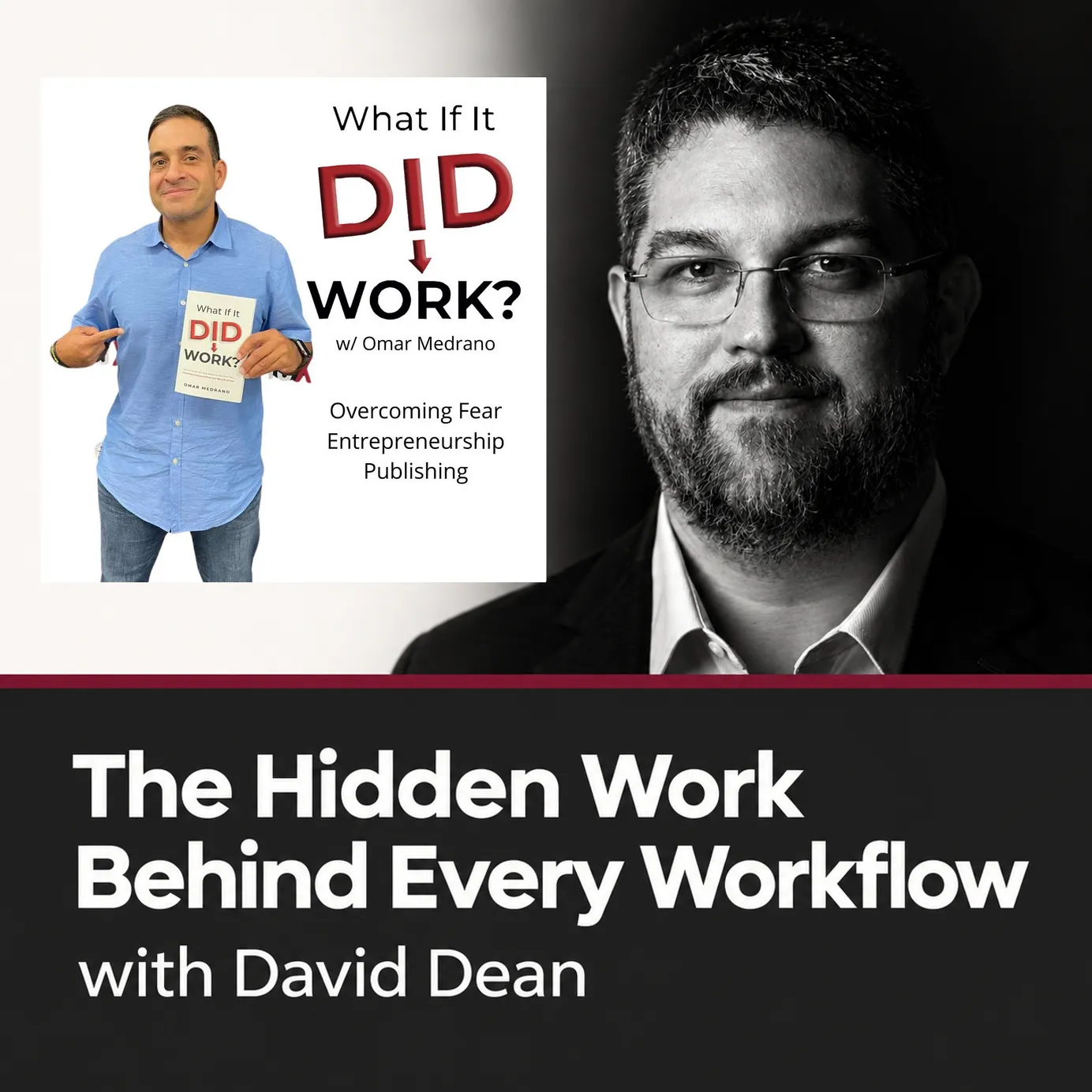
The Hidden Work Behind Every Workflow
Hosted by Omar Medrano
AI is becoming a mirror that shows organizations the truth about how work gets done, including the messy, undocumented parts nobody puts in the handbook.
Original episode
Listen or watch
Conversation summary
AI hype makes it sound like the future is a winner-take-all race between humans and machines. We take a different angle: AI is becoming a mirror that shows organizations the truth about how work gets done, including the messy, undocumented parts nobody puts in the handbook. When you connect AI to the tools where work actually lives (email, chat, meeting transcripts, spreadsheets, shared docs), you are not just adding productivity software. You are turning daily behavior into something that can be searched, summarized, and questioned. That can be liberating, and it can also be uncomfortable.
My guest, enterprise technologist and author David Dean, explains why the “inbox” is really a behavioral record and why the gap between the official process and the real process is where most companies get stuck. We dig into approval bottlenecks, meeting overload, and the quiet workarounds people build to keep things moving. Then we tackle the hard warning: if you automate a bad process, you do not get efficiency, you get faster dysfunction, and you pay for it at scale. AI can also create an illusion of productivity, producing polished outputs while goals stay unchanged, unless leaders and teams keep judgment and accountability where they belong.
We also talk about what AI reveals inside culture: missing decision ownership, uneven responsiveness, and the kind of behavioral analytics that forces authenticity from leaders. For employees, we explore a practical “step zero” approach to organizational self-discovery, plus why lived experience and lived consequence still matter even in a world of powerful models.
If you want a smarter, more realistic AI strategy for modern work, listen now, then subscribe, share this with a teammate, and leave a review with your biggest takeaway. What would AI uncover in your organization if you let it look at how work really happens?
Key insights
- The inbox is a metaphor for the behavioral record: the communication and collaboration data that shows how people actually get work done.
- A documented process can hide the conversations, spreadsheets, and workarounds needed to complete a single step. Those arrangements often become permanent because employees had no other tools available.
- An approval delay may come from unclear authority or an overloaded calendar. Understanding the cause can lead to a conversation, delegation, or a workload change.
- Automating a poorly understood process can scale its dysfunction and add usage costs. David recommends finding a specific step worth improving before expanding the investment.
- Polished AI outputs can create an appearance of productivity while leaving the underlying goal unmet. People still need to judge what the work accomplishes.
- AI can make patterns in leadership communication easier to examine. David argues that this visibility will put more pressure on leaders to act consistently with their stated principles.
- Employees can begin self-discovery by dictating how their work happens, what frustrates them, and where they get stuck. AI can help identify signals; the person still decides what to do.
- Creating breathing room gives employees time to pursue ideas, collaborate, and improve their roles. David connects that opportunity to the institutional knowledge companies depend on.
Questions answered
Why does David call the inbox a behavioral record?
He uses the inbox as a metaphor for email, messages, meeting transcripts, and other collaboration data. These records contain traces of how employees coordinate work, handle ambiguity, and make decisions beyond the official process.
What can an approval bottleneck reveal?
David describes an approver who does not feel authorized to decide, and another whose meeting schedule leaves little time to review requests. The response depends on the cause: clarify authority, delegate the decision, or change the workload. Buying another tool may leave that cause untouched.
How can a company start with a manageable AI improvement?
Find one slow step in an otherwise functioning process. David gives a hypothetical call-center example: reducing a research task from five minutes to thirty seconds. The company can examine the value of that improvement at its own volume before committing to a larger project.
Who is accountable for a decision informed by AI?
The person taking action remains responsible. David describes the risk of an executive asking AI to analyze an exported spreadsheet without establishing whether the data is complete and accurate. An AI answer does not remove the need to understand the decision or its downstream consequences.
What does “step zero” look like for an employee?
David suggests opening a notes app and dictating the story of how the job actually works, including frustrations and recurring problems. The employee can then ask AI to examine that material for patterns and possible actions, using their own experience to judge what the findings mean.
What should leaders tell teams worried about AI?
Acknowledge the work and ambiguity employees already carry. David recommends giving people time to address the ideas and improvements they cannot reach while keeping daily operations moving. That message needs the opportunity to act on it: time to think, collaborate, and improve the work.
Conversation guide
The inbox as a behavioral record
At 2:45David explains the metaphor behind the book and why communication data offers a view of how work happens.
The official and unwritten contracts
At 6:00Job descriptions and procedures meet the undocumented coordination needed to get the job done.
Approval bottlenecks
At 13:44Unclear decision authority and meeting overload show why some delays call for changes in how people work.
Automating dysfunction
At 18:07David compares throwing AI at a broken process to adding more people without understanding the work.
Productivity and leadership visibility
At 20:08The discussion moves from polished outputs to what communication patterns can reveal about leadership behavior.
Judgment and accountability
At 26:24An executive decision based on an AI analysis illustrates why responsibility stays with the person acting.
Changing jobs and institutional knowledge
At 30:22David discusses evolving roles, difficult customer problems, and the knowledge frontline employees carry.
Start with one useful improvement
At 37:16A hypothetical call-center research task illustrates how a small improvement can support a larger investment.
Clarity before acceleration
At 41:30Dictating the story of everyday work provides a starting point for self-discovery and human decisions.
Give employees breathing room
At 44:44Leaders can acknowledge hidden work and create time for employees to pursue ideas and collaborate.
Institutionalized workarounds
At 48:16The conversation examines why improvised processes persist and how their accumulated risks need attention.
The Observant Climb
At 51:34David contrasts using the behavioral record to manipulate a leader with using it to learn how to contribute.
Timecodes correspond to the supplied episode transcript.
Edited transcript excerpts
Speaker labels and punctuation were reconstructed from automated transcription and edited for readability.
“His argument is fascinating. AI isn't simply another productivity tool. It's becoming a mirror that can expose how an organization really operates.”
“Then there’s the unwritten contract, which is how we actually behave, like how we actually get the job done.”
“So no matter what AI produces for you, you are still accountable and responsible for taking action on anything it says out there.”
“And if you don’t understand why, then you shouldn’t be making a decision from it until you understand why.”
“You don’t have to automate everything, even a single step can have huge ROI, depending on how much your volume is.”
“Open up your notes app or notes app equivalent, tap the dictate button and start telling your story.”
“David, thank you for the book. Thank you for the opportunity of just having a conversation with you, brother.”
Keep exploring
Follow the idea without losing your place
Start with the closest connections. Open the additional links only when you want to go further.
Reading
Related articles
Source
Original episode
Continue the conversation
Explore the book behind these ideas, bring the conversation to an audience, or learn more about David’s work.